Constitutionalism, Multilevel Trade Governance and International Economic Law
Edited by Christian Joerges and Ernst-Ulrich Petersmann
Hart Publishing 2011
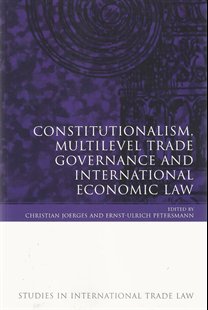 This is a book about the ever more complex legal networks of transnational economic governance structures and their legitimacy problems. It takes up the challenge of the editors' earlier pioneering works which have called for more cross-sectoral and interdisciplinary analyses by scholars of international law, European and international economic law, conflict of laws, international relations theory and social philosophy to examine the interdependences of multilevel governance in transnational economic, social, environmental and legal relations. Two complementary strands of theorising are expounded. One argues that globalisation and the universal recognition of human rights are transforming the intergovernmental 'society of states' into a cosmopolitan community of citizens which requires more effective constitutional safeguards for protecting human rights and consumer welfare in the national and international governance and legal regulation of international trade. The second emphasises the dependence of the functioning of international markets and liberal trade on governance arrangements that respond credibly to safety and environmental concerns of consumers, traders, political and non-governmental actors. Enquiries into the generation of international standards and empirical analyses of legalisation and judicialisation practices form part of this agenda.
The perspectives and conclusions of the more than 20 contributors from Europe and North-America cannot be uniform. But they converge in their search for a constitutional architecture which limits, empowers and legitimises multilevel trade governance, as well as in their common premise that respect for human rights, private and democratic self-government and social justice require more transparent, participatory and deliberative forms of transnational 'cosmopolitan democracy'.
This second paperback edition replaces Chapters 15 to 18 of the first edition published in 2006 by four new chapters examining the alternative conceptions of 'International Economic Law' and 'Multilevel Governance' from diverse public and private, national and international law perspectives.
Table of Contents
Section I: International Trade Law: Constitutionalisation and Judicialisation in the WTO and Beyond
Section I.1 Constitutionalisation and the WTO: Two Competing
Visions from Two Different Disciplines Multilevel Trade Governance in the WTO Requires Multilevel Constitutionalism
Ernst-Ulrich Petersmann
2. Democratic Legitimacy of Transnational Trade Governance: A View from Political Theory
Patrizia Nanz
Section I.2 Judicialisation: Empirical Inquiries and Constitutional Concerns
3. Dispute Settlement under GATT and WTO: An Empirical Enquiry into a Regime Change
Achim Helmedach and Bernhard Zangl
4. The Appellate Body’s ‘Response’ to the Tensions and Interdependencies Between Transnational Trade Governance and Social Regulation
Christiane Gerstetter
Section I.3 Participatory Governance: Emerging Patterns and their Juridification
5. Why Co-operate? Civil Society Participation at the WTO
Jens Steffek and Claudia Kissling
6. Legal Patterns of Global Governance: Participatory Transnational Governance
Rainer Nickel
Section I.4 Legalisation Patterns outside the WTO
7. Non-Traditional Patterns of Global Regulation: Is the WTO ‘Missing the Boat’?
Joost Pauwelyn
8. Conflicts and Comity in Transnational Governance: Private International Law as Mechanism and Metaphor for Transnational Social Regulation through Plural Legal Regimes
Robert Wai
Section II: Transnational Governance Arrangements for Product Safety
Section II.1 Food Safety Regulation: the SPS Agreement and the Codex Alimentarius
9. Fixing the Codex? Global Food-Safety Governance Under Review
Thorsten Hüller and Leo Maier
10. The Precautionary Principle in Support of Practical Reason: an Argument Against Formalistic Interpretations of the Precautionary Principle
Alexia Herwig
11. Beyond the Science/Democracy Dichotomy: The World Trade Organisation Sanitary and Phytosanitary Agreement and Administrative Constitutionalism
Elizabeth Fisher
12. Administrative Globalisation and Curbing the Excesses of the State
Damian Chalmers
Section II.2 The TBT Agreement and International Standardisation
13. A New Device for Creating International Legal Normativity:
The WTO Technical Barriers to Trade Agreement and ‘International Standards’
Robert Howse
14. The Empire’s Drains: Sources of Legal Recognition of Private Standardisation under the TBT Agreement
Harm Schepel
Section III: Alternative Conceptions of International Economic Law and Multilevel Governance
15. The Idea of a Three-dimensional Conflicts Law as Constitutional Form
Christian Joerges
16. The World Trade Organization and Global Administrative Law
Richard B Stewart and Michelle Ratton Sanchez-Badin
17. Towards a Five Storey House
Thomas Cottier
18. The Future of International Economic Law: A Research Agenda
Ernst-Ulrich Petersmann
Page last updated on 05 April 2024