Posted on 08 October 2010
The European University Institute has awarded Honoris Causa Degrees to Sabino Cassese, Jürgen Kocka and Richard Rose.
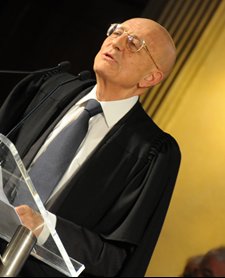
Sabino Cassese has been honoured by the EUI in his striving to recapture the idea of the universality of law, and in his breaking the barriers of legal nationalism, a by-product of the Westphalian setting of the international society.
His books on administrative law, global law and democracy, judges and global law, the new world of law, and his many courses, in different languages and in different parts of the world, carry the constant message of innovation.
In his work Cassese brings together the wisdom of the old tradition of Roman Law as a universal system of human ordering, and the innovation required by modernity and by the inexorable process of erosion of the national frontiers of the law.
Without ever leaving active teaching and research, Cassese has worked for the Italian Parliament as a member of the Commission on the Limits of Competition, he has chaired a number of ministerial commissions, and in the 1990s he was Minister of Public Functions in the Government headed by Carlo Azeglio Ciampi. Since 2008 he has been judge in the Italian Constitutional Court.
The hallmark and intellectual legacy of such an outstanding career ca be summarized in two words: ‘tradition’ and ‘innovation’. Cassese brings us the lesson that "... creative vitality is a reserve of the past: we can innovate when we have a rich past: genius is wisdom and youth" (Cesare Pavese)
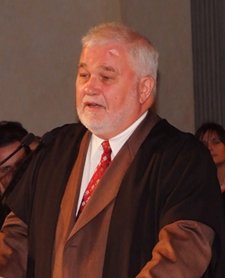
The European University Institute and the Department of History and Civilization have honoured the importance and accomplishments of Jürgen Kocka as an internationally recognized organizer of scientific work, as a scientist who writes history in an interdisciplinary manner, and as one of the leading historians of the history of Europe.
Not only was Kocka the long-standing director of Europe's largest centre of social science research, the Wissenschaftszentrum Berlin HGH (WZB), but he was also the President of the International Association of Historians.
Moreover, he has developed a critical use of concepts of social science research in his own writing as, for example, the concepts of class or civil society.
Finally, he has been one of the most important promoters of the study of comparative history in Europe.
In his work he has compared the evolution of the bourgeoisie in various European countries during the nineteenth century, and the history of white-collar workers in Germany and the United States during the 20th century.
The Department of History and Civilization is proud that our own methodological focus so closely approaches that of the eminent Prof. Kocka.
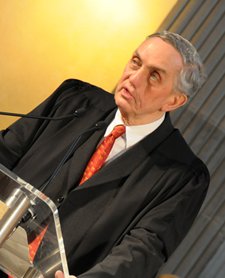
Richard Rose has been honoured by the EUI as one of the founding fathers of postwar European political science. He was one of the original initiators of the European Consortium for Political Research (ECPR) and succeeded Stein Rokkan as secretary to the influential IPSA/ISA Committee on Political Sociology.
He is also a highly prolific scholar who has made a substantial and significant contribution to a wide range of fields in political science, including British politics, American politics, comparative European politics more generally, EU politics and post-communist politics.
He has written, and continues to write, on elections, voters, governments, and political parties, and was one of the founders of the study of public policy, serving as the first and long-term editor of the Journal of Public Policy.
Richard Rose has been a pioneer of cross-national European research, and, after 1989, he was one of the first political scientists to study attitudes towards democracy in the post-communist systems. The range of his work is enormous, his contribution to the discipline is inestimable, and he has always been at the forefront of comparative research.